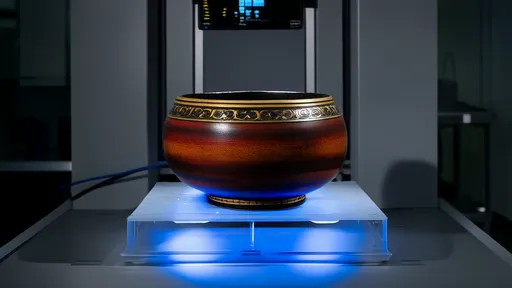
The field of cultural heritage preservation has entered a new era with the advent of terahertz (THz) scanning technology. This cutting-edge method is revolutionizing how archaeologists, conservators, and historians examine fragile artifacts without causing any damage. Unlike traditional X-rays or infrared imaging, terahertz waves occupy a unique region of the electromagnetic spectrum, offering unprecedented clarity and depth in non-invasive analysis.
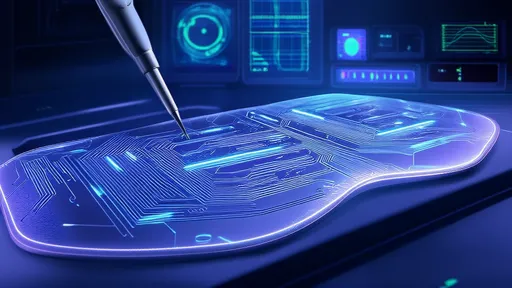
Museums and research institutions worldwide are increasingly adopting terahertz scanners to peer beneath the surface of ancient objects. The technology works by emitting short pulses of terahertz radiation—between microwave and infrared frequencies—which penetrate various materials differently. As these pulses reflect off internal structures, sophisticated detectors create detailed cross-sectional images revealing hidden layers, repairs, or even previously unknown inscriptions.
What makes terahertz imaging particularly remarkable is its ability to distinguish between materials that appear identical to the naked eye or under other imaging techniques. For instance, conservators at the Louvre recently used THz scanning to differentiate between original paint layers and later restorations on a 14th-century altarpiece. The system clearly showed where Renaissance-era conservators had touched up the work, enabling accurate preservation decisions without removing a single pigment particle.
The British Museum's ongoing project with terahertz scanners has uncovered fascinating details about Egyptian burial artifacts. Many mummy wrappings contain amulets and jewels placed between linen layers—items completely invisible in standard CT scans due to the wrappings' density. THz waves, however, pass through these fibrous materials while bouncing off metallic and mineral inclusions, creating a map of hidden treasures. This capability is transforming our understanding of ancient funerary practices.
Beyond mere discovery, terahertz technology provides crucial information about an object's condition. The waves detect microscopic cracks, moisture content, and material degradation invisible to conservators. This allows for preventive measures before damage becomes visible. At the Vatican Archives, THz scanners identified parchment documents at risk of crumbling from within due to ancient ink corrosion—saving texts that would have been lost within decades.
One groundbreaking application involves illuminated manuscripts. The intense colors in medieval texts often contain rare pigments that degrade over time. Terahertz imaging helps identify which pages need specialized lighting conditions by mapping pigment distribution at a molecular level. The Bodleian Library has used this approach to develop customized display cases that minimize light exposure to vulnerable areas while keeping other sections visible.
The technology isn't limited to organic materials like wood, paper, or textiles. Recent experiments at MIT have successfully applied terahertz scanning to ancient metallic objects, revealing manufacturing techniques. A scan of a Bronze Age dagger showed distinct THz reflections indicating where the metal had been folded during forging—a detail impossible to see with conventional metallography without destructive sampling.
Perhaps most exciting is terahertz imaging's potential to decode lost writings. Many ancient documents were scraped clean and reused (palimpsests), with the original text assumed lost forever. However, different inks penetrate parchment fibers to varying depths. THz scans can detect these depth variations, allowing researchers to reconstruct erased texts. A team in Greece recently recovered 70% of a previously unknown Aristotelian treatise hidden beneath a medieval prayer book using this method.
Despite its promise, terahertz scanning faces challenges. The equipment remains expensive, requiring specialized lasers and detectors. Additionally, interpreting the complex data requires trained experts—a skill set still rare in the conservation community. However, as the technology matures and becomes more accessible, it's poised to become as fundamental to artifact analysis as radiocarbon dating became in the 20th century.
Several startups are now developing portable THz scanners that could bring this technology to archaeological digs worldwide. Imagine uncovering a Roman villa and immediately scanning fresco fragments to determine which require urgent stabilization—all before transporting delicate finds to laboratories. This real-time analysis could prevent countless artifacts from deteriorating during excavation and transit.
The ethical implications are equally profound. Many indigenous communities object to destructive testing of sacred objects. Terahertz scanning offers a respectful alternative for studying ceremonial items while preserving their physical and spiritual integrity. The National Museum of the American Indian has begun using THz technology to examine ritual objects in consultation with tribal elders, creating a new model for collaborative research.
As terahertz technology evolves, its resolution improves exponentially. Early systems could only distinguish features several millimeters apart. The latest generation achieves micron-level precision, enabling the study of individual brushstrokes in Old Master paintings or tool marks on prehistoric carvings. This granularity provides art historians with unprecedented insights into creative processes across civilizations.
Looking ahead, researchers anticipate combining terahertz data with artificial intelligence for automated artifact analysis. Machine learning algorithms trained on thousands of THz scans could instantly identify material compositions, manufacturing periods, or even workshops of origin. Such systems might one day provide instant authentication for disputed artworks or detect forgeries with superhuman accuracy.
The marriage of advanced physics and cultural preservation through terahertz scanning represents more than technical achievement—it's a philosophical shift in how we engage with humanity's material legacy. By revealing hidden histories without altering their physical vessels, this technology ensures future generations can make their own discoveries in artifacts we study today. As the famous adage adapted for the digital age might go: True preservation means leaving no trace, while seeing everything.

By /Aug 15, 2025

By /Aug 26, 2025

By /Aug 15, 2025
By /Aug 15, 2025

By /Aug 15, 2025
By /Aug 15, 2025

By /Aug 26, 2025

By /Aug 15, 2025
By /Aug 26, 2025

By /Aug 15, 2025

By /Aug 26, 2025

By /Aug 15, 2025
By /Aug 15, 2025

By /Aug 15, 2025

By /Aug 15, 2025
By /Aug 15, 2025

By /Aug 15, 2025

By /Aug 15, 2025

By /Aug 26, 2025
By /Aug 15, 2025