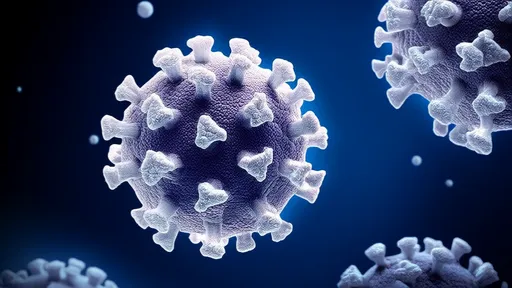
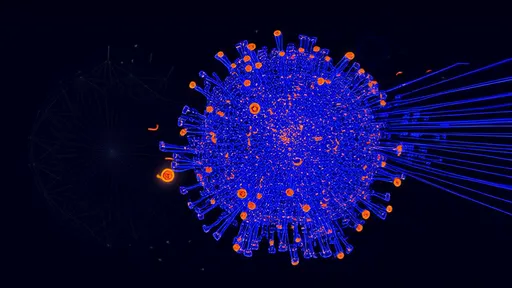
The intricate dance of viral capsid proteins has long fascinated structural biologists, yet its dynamic choreography remained largely cryptic until cryo-electron microscopy (cryo-EM) began capturing these nanoscale movements in unprecedented detail. Recent breakthroughs in high-resolution cryo-EM have peeled back the curtain on how viral shells breathe, twist, and warp during critical stages of infection – revealing a hidden language of conformational changes that govern viral replication and immune evasion.
At the heart of this revolution lies the ability to freeze viral particles in multiple transitional states, capturing what traditional crystallography could only hint at. Unlike static snapshots, cryo-EM reconstructions of dynamic capsids show asymmetric deformations that occur when viruses prepare for genome release or navigate host defenses. The herpesvirus capsid, for instance, demonstrates remarkable plasticity as its icosahedral symmetry breaks down during nuclear egress, with individual hexons tilting up to 15 degrees to accommodate environmental pressures.
What emerges from these studies is a paradigm shift – viral shells are not rigid containers but sophisticated molecular machines with encoded flexibility. The adenovirus penton base undergoes coordinated twisting motions that facilitate endosomal escape, while HIV-1's conical capsid displays shock-absorbing properties through hexamer sliding. These deformation patterns aren't random; they follow precise structural logic where weak interfaces serve as molecular hinges and stress concentrators guide controlled disassembly.
The implications extend far beyond basic virology. Pharmaceutical researchers are mining these deformation maps to identify cryptic pockets that appear transiently during capsid breathing – potential targets for next-generation antivirals. One striking example comes from hepatitis B virus (HBV), where cryo-EM revealed how core protein dimers rotate to expose hidden binding sites during maturation, explaining the mechanism of certain capsid assembly modulators now in clinical trials.
Perhaps most astonishing are the evolutionary insights gleaned from comparing capsid dynamics across viral families. Picornaviruses and flaviviruses, despite differing vastly in genetic makeup, both employ a similar asymmetric collapse mechanism for genome release. This convergence suggests universal physical principles governing how protein shells balance stability with disassembly – a realization only possible through comparative analysis of cryo-EM-derived conformational landscapes.
Technical innovations continue pushing the boundaries of what we can observe. Time-resolved cryo-EM now captures sub-second capsid transformations, while deep learning algorithms reconstruct continuous deformation pathways from heterogeneous particle populations. These tools recently uncovered how giant mimivirus capsids undergo phase-transition-like restructuring when encountering acidic environments, a finding that rewrites textbook models of viral entry mechanisms.
Yet mysteries persist. The energy landscape governing capsid dynamics remains poorly quantified, and the role of solvent molecules in facilitating large-scale motions is just beginning to be understood. Emerging techniques like cryo-electron tomography and sub-particle analysis promise to reveal how capsids interact with host factors during deformation – potentially unlocking new antiviral strategies that exploit viral mechanics rather than chemistry.
As the field progresses, one truth becomes increasingly clear: understanding viruses requires seeing them not as frozen structures but as dynamic entities constantly shifting between metastable states. The deformation codes now being deciphered through cryo-EM represent more than academic curiosities – they form the playbook for outmaneuvering some of medicine's most persistent adversaries at their own structural game.

By /Jul 28, 2025

By /Jul 28, 2025
By /Jul 28, 2025
By /Jul 28, 2025
By /Jul 28, 2025

By /Jul 28, 2025
By /Jul 28, 2025

By /Jul 28, 2025

By /Jul 28, 2025
By /Jul 28, 2025
By /Jul 28, 2025

By /Jul 28, 2025

By /Jul 28, 2025

By /Jul 28, 2025

By /Jul 28, 2025
By /Jul 28, 2025

By /Jul 28, 2025
By /Jul 28, 2025

By /Jul 28, 2025

By /Jul 28, 2025