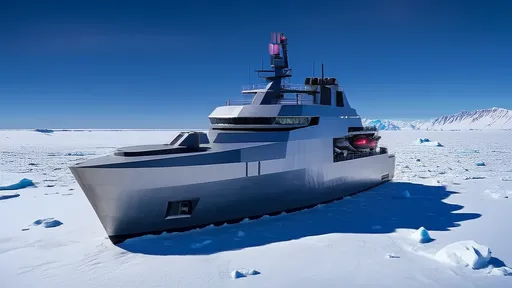
The Arctic, once a frozen frontier impenetrable to most vessels, is now opening up due to the accelerating effects of climate change. As ice melts at an unprecedented rate, new shipping routes are emerging, promising to cut transit times between Asia, Europe, and North America by thousands of nautical miles. However, navigating these treacherous waters remains a formidable challenge. Enter the era of autonomous icebreakers equipped with AI-driven real-time ice navigation systems—a technological leap that could revolutionize Arctic shipping.
The Changing Face of Arctic Navigation
For centuries, the Arctic was a no-go zone for commercial shipping. Thick ice, extreme weather, and unpredictable conditions made it nearly impossible to traverse. But with rising global temperatures, the ice cover has been shrinking by roughly 13% per decade. The Northern Sea Route (NSR) along Russia’s coast and the Northwest Passage through Canada’s archipelago are becoming increasingly viable, offering shortcuts that could save shipping companies millions in fuel and time.
Yet, the Arctic remains a hazardous environment. Traditional icebreakers—powerful ships designed to plow through ice—are expensive to operate and require skilled crews. Even with their assistance, navigation is slow and risky. The solution? Autonomous icebreakers guided by artificial intelligence, capable of analyzing real-time ice conditions and charting the safest, most efficient paths through the frozen labyrinth.
How AI-Powered Ice Navigation Works
At the heart of this innovation is a combination of satellite imagery, onboard sensors, and machine learning algorithms. Satellites like the European Space Agency’s Copernicus program provide high-resolution images of ice thickness, concentration, and movement. These images are fed into AI systems that process the data alongside inputs from radar, sonar, and infrared cameras mounted on the ship itself.
The AI doesn’t just react to current conditions—it predicts them. By analyzing historical ice patterns and weather data, the system can forecast how the ice will shift in the coming hours or days. This allows the vessel to adjust its route proactively, avoiding areas where ice is likely to thicken or converge. The result is a dynamic, ever-evolving navigation plan that maximizes safety and efficiency.
Human oversight isn’t entirely removed from the equation. While the ship can operate autonomously, remote monitoring stations staffed by human experts ensure that critical decisions—especially in unexpected scenarios—receive a second layer of scrutiny. This hybrid approach balances the speed and precision of AI with the nuanced judgment of experienced mariners.
The Role of Autonomous Icebreakers
Unlike conventional icebreakers, which rely on brute force to smash through ice, autonomous versions are designed for finesse. Their AI systems identify the weakest points in the ice—cracks, thin patches, or areas where currents have created natural channels—allowing the ship to navigate with minimal resistance. This not only conserves energy but also reduces wear and tear on the vessel.
Another advantage is scalability. Autonomous icebreakers can operate around the clock without crew fatigue, and multiple vessels can be coordinated as a fleet, working in tandem to clear paths for commercial ships. Some designs even envision "mothership" configurations, where a larger autonomous vessel leads a convoy of crewed cargo ships through the ice.
The environmental benefits are equally compelling. By optimizing routes and reducing unnecessary icebreaking, these ships minimize fuel consumption and emissions. In an era where the Arctic is both a victim of and a contributor to climate change (due to melting permafrost releasing greenhouse gases), reducing the carbon footprint of shipping in the region is a pressing priority.
Challenges and Ethical Considerations
Despite the promise, significant hurdles remain. The Arctic’s extreme conditions pose a severe test for even the most robust technology. Sensors can freeze, satellite signals may drop, and unpredictable storms can arise with little warning. Ensuring that AI systems can handle these variables—and fail safely when necessary—is a major engineering challenge.
There are also geopolitical tensions to navigate. The Arctic is a hotspot for territorial disputes, with nations like Russia, Canada, and the U.S. vying for control over shipping lanes and resource-rich seabeds. Autonomous vessels, which could operate with less transparency than crewed ships, might exacerbate these tensions if not regulated carefully.
Indigenous communities in the Arctic have raised concerns as well. Increased shipping traffic, even if autonomous, could disrupt traditional hunting and fishing practices, not to mention the risk of oil spills or other environmental disasters. Engaging these communities in the development and deployment of this technology will be crucial to ensuring it benefits all stakeholders.
The Future of Arctic Shipping
Autonomous icebreakers are still in the experimental phase, but early trials have been promising. In 2022, a semi-autonomous vessel successfully navigated a section of the Northern Sea Route with minimal human intervention. As the technology matures, it could become a cornerstone of Arctic logistics, enabling safer, faster, and more sustainable shipping in one of the planet’s most challenging environments.
The implications extend beyond commerce. Reliable Arctic routes could reshape global supply chains, reduce reliance on congested chokepoints like the Suez Canal, and even open new avenues for scientific research. But as with any transformative technology, the key to success lies in balancing innovation with responsibility—ensuring that the drive to conquer the Arctic doesn’t come at the expense of the very ecosystems and communities that call it home.

By /Jul 28, 2025
By /Jul 28, 2025

By /Jul 28, 2025

By /Jul 28, 2025

By /Jul 28, 2025

By /Jul 28, 2025

By /Jul 28, 2025

By /Jul 28, 2025

By /Jul 28, 2025
By /Jul 28, 2025
By /Jul 28, 2025
By /Jul 28, 2025

By /Jul 28, 2025

By /Jul 28, 2025

By /Jul 28, 2025

By /Jul 28, 2025

By /Jul 28, 2025

By /Jul 28, 2025

By /Jul 28, 2025

By /Jul 28, 2025