For decades, neuroscientists have sought ways to visualize the fleeting dance of neurotransmitters in the living brain. The recent convergence of nanotechnology and neurobiology has birthed a revolutionary approach—quantum dot-based tracking of dopamine release. This technique isn't just another imaging tool; it's a paradigm shift in how we observe the brain's chemical conversations at nanometer scales.
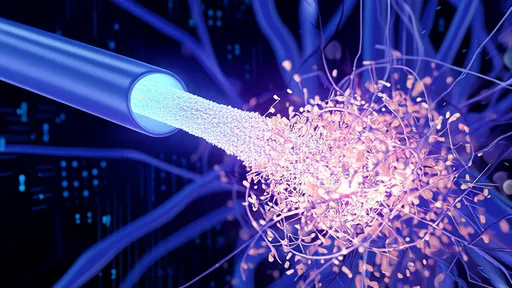
Traditional methods like microdialysis or voltammetry provided snapshots of dopamine activity but lacked the spatiotemporal resolution to capture its rapid-fire dynamics. Quantum dots (QDs), semiconductor nanocrystals with extraordinary optical properties, have shattered these limitations. When engineered to target dopamine receptors or transporters, these luminous nanoparticles become molecular beacons, lighting up synaptic clefts as neurotransmitters flood the space between neurons.
The magic lies in QDs' tunable fluorescence. Unlike organic dyes that photobleach within minutes, quantum dots maintain their brilliance for hours. Their narrow emission spectra allow multiplexing—researchers can now track dopamine alongside glutamate or serotonin by tagging each neurotransmitter with distinct QD colors. Early adopters at Stanford have captured dopamine "waves" propagating through striatal circuits during reward learning, revealing patterns invisible to previous technologies.
What makes this breakthrough particularly compelling is its dual-mode capability. Certain QD formulations exhibit fluorescence changes upon dopamine binding while simultaneously generating electrochemical signals. This hybrid readout provides cross-validated data, eliminating artifacts that plagued single-modality approaches. A 2023 Nature Neuroscience study demonstrated how this feature uncovered dopamine "microsparks"—brief, localized releases preceding full vesicular fusion.
Implementation challenges remain. Delivering QDs across the blood-brain barrier requires sophisticated targeting strategies, often involving peptide-modified surfaces. There's also the matter of signal quantification—researchers are developing machine learning pipelines to distinguish true neurotransmitter events from background noise in the QD's shimmering glow.
Already, the clinical implications are coming into focus. Teams at MIT have adapted the technology to track dopamine pathology in Parkinson's organoids, observing how Lewy body formation disrupts release kinetics. Meanwhile, psychiatric researchers are mapping dopamine dysregulation in depression models with unprecedented granularity. The next frontier? Integrating QD tracking with optogenetics to achieve closed-loop control of neurotransmitter systems.
As the method matures, ethical considerations emerge alongside the science. The same properties making QDs ideal for brain imaging—their persistence and brightness—raise questions about long-term neural effects. Leading labs are addressing this through biodegradable silicon QDs that safely degrade after imaging sessions.
This isn't merely a better microscope for watching dopamine. Quantum dot neurotracking represents a fundamental change in our relationship with the brain's chemical language. By transforming neurotransmitters from inferred quantities into visible entities, it brings us closer than ever to decoding the molecular poetry of thought, emotion, and behavior.
By /Jul 28, 2025

By /Jul 28, 2025
By /Jul 28, 2025
By /Jul 28, 2025

By /Jul 28, 2025

By /Jul 28, 2025

By /Jul 28, 2025

By /Jul 28, 2025
By /Jul 28, 2025

By /Jul 28, 2025

By /Jul 28, 2025

By /Jul 28, 2025

By /Jul 28, 2025
By /Jul 28, 2025

By /Jul 28, 2025
By /Jul 28, 2025
By /Jul 28, 2025

By /Jul 28, 2025

By /Jul 28, 2025
By /Jul 28, 2025